
A Specialized Consultation and Treatment Service for Adopted Persons and Their Families
Northstar Clinical Consultants is the over-arching name for a number of independently-practicing senior state-licensed psychotherapists who specialize in helping adopted persons and their families obtain help that they believe may be related to adoption. If the request is for psychotherapy, the therapist needs to be licensed in the same state in which the client resides. However, if the interest is in a relatively brief specialized consultation, perhaps about a specific concern of the client’s, this can be provided online via Zoom. An initial online half-hour consultation can be provided at no charge.
A Note for Mental Health Professionals
There is much in the literature about treatment of adoptive families with young children, as well as reports of sociological/social work-based studies. However, very little has focused on the actual development and psychology of the adopted person as they grow into adolescence and adulthood. This is the theme of a new book published by Routledge, for which three of the Northstar specialists are editors:
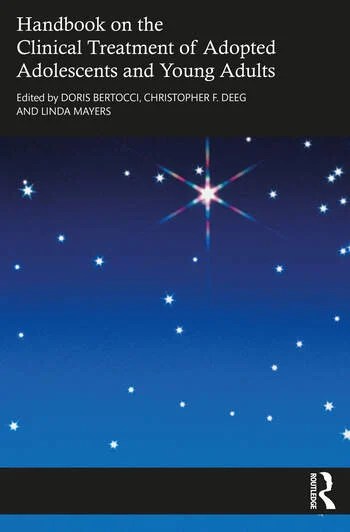
Front cover for the paperback version.
This volume has been written primarily for professionals in the medical and mental health fields who treat adopted young people in the 13-30 year old age range. An important premise is that the fullest impact and greatest complexity of being adopted usually comes in adolescence and young adulthood rather than in earlier childhood. This perspective is one of many that contradict the narratives of the adoption culture, contributing to the limited knowledge-base of psychotherapists. As a consequence, their treatment efforts are likely to be misdirected. Adopted persons undergo an alternate development that requires modifications in their treatment. While many systemic problems are observed, the main focus is on therapeutic evaluation and practice from the clinical perspective of understanding the internal life of the adopted client who is no longer a young child.
We maintain that treatment of the adopted person requires an understanding of them as an individual on their own terms separate from, as well as part of, her/his complex family system involving two or more families.
If a psychotherapist has already started treating an adopted person, Northstar is available to offer consultation to either party. Either way, we can provide a great deal of information to fill in gaps in what they may know about various adoption topics. For the therapist, we view these consultations as a means of clarifying areas in which the therapist may not be familiar so that treatment can be more effectively focused. For example, some adopted clients wish to discuss their thoughts about searching for information about their birth relatives. Any aspect of “the search” is a very complex topic and we advise therapists to consult the Handbook mentioned above.
Consultations and Training for Psychotherapists
If a therapist believes it would be helpful to their treatment if the client had a consultation with one of the Northstar specialists for specific adoption-related concerns, this could be worked out through a collaborative arrangement.
Northstar is now offering an online training seminar that meets monthly, with more planned at additional times. See Our Clientele & Services
Notes for Adopted Persons
We have reason to believe that adopted adolescents and young adults have most likely seen more therapists than their non-adopted peers. There are many reasons for this, one of them being that many have had frustrating experiences seeing counselors or therapists who were not familiar with the complexities of being adopted. Many adopted people need to see therapists who are not only well-informed about certain details about adoption, but who can provide treatment at a deeper level having to do with all that is active in the client’s mind and emotions, including the areas that are forgotten, confused, or possibly distorted by earlier experiences.
Being adopted is only part of a much larger life experience in personal development. A well-informed therapist can help the client learn what may or may not be related to adoption issues. What we do know is that the adopted person’s lived experience is far more complicated than that of most of their non-adopted peers. This begins with the complexity of their having a birth family that they may or may not know anything about. The adopted person wants to work out, within themselves, who they have become as persons, and perhaps why or how, and integrate all of the fragments from their earlier lives.
Northstar consultants can work with the adopted client or family member at whatever level they wish to work, depending on what they want to get out of either a consultation or treatment. This can be clarified in the initial FREE ONLINE CONSULTATION.
How do I know what kind of therapist would be best for me?
This depends on what you want to accomplish (your goals) and what kind of experience you want to have with a therapist. If you have seen a previous therapist, you might want to think through what worked and what may not have worked in your previous experiences. Most of the services available through agencies or programs featuring adoption services are provided at the counseling level. This means that the counselor is knowledgeable about one or more areas of the adoption field and provides psychoeducational, supportive, and/or psychotherapy within a cognitive-behavioral framework. Depending on the needs of the client, this typically focuses on helping the client change the way they think (such as helping with their misunderstandings and needs for more accurate information). Adoption social workers, counselors, and therapists described above typically bring their knowledge about adoptive family life in the earliest years but are also trained to understand the struggle of the birthparents, an important part of the “adoption triad.”.
Experienced clinicians in the mental health field who specialize in the psychology of being adopted, which is very different from counseling-level “skill sets,” already have these skill sets but, further, they work at a deeper level in working with the client’s feelings (emotions). There is much that we may not be aware of, such as hidden memories, or why people act the way they do, and this deeper form of psychotherapy helps the person learn what is “behind the curtain,” that is, what they are not aware of in their personality and in both their thoughts and feelings. Because of the complexities at this level of therapeutic work, adoption-knowledgeable clinicians need to have advanced training and experience. Since didactic clinical training is not yet available, therapists are encouraged to arrange consultation with a specialist such as those listed in this website.
The way adopted people report their experience with previous therapists.

 Northstar Consulting